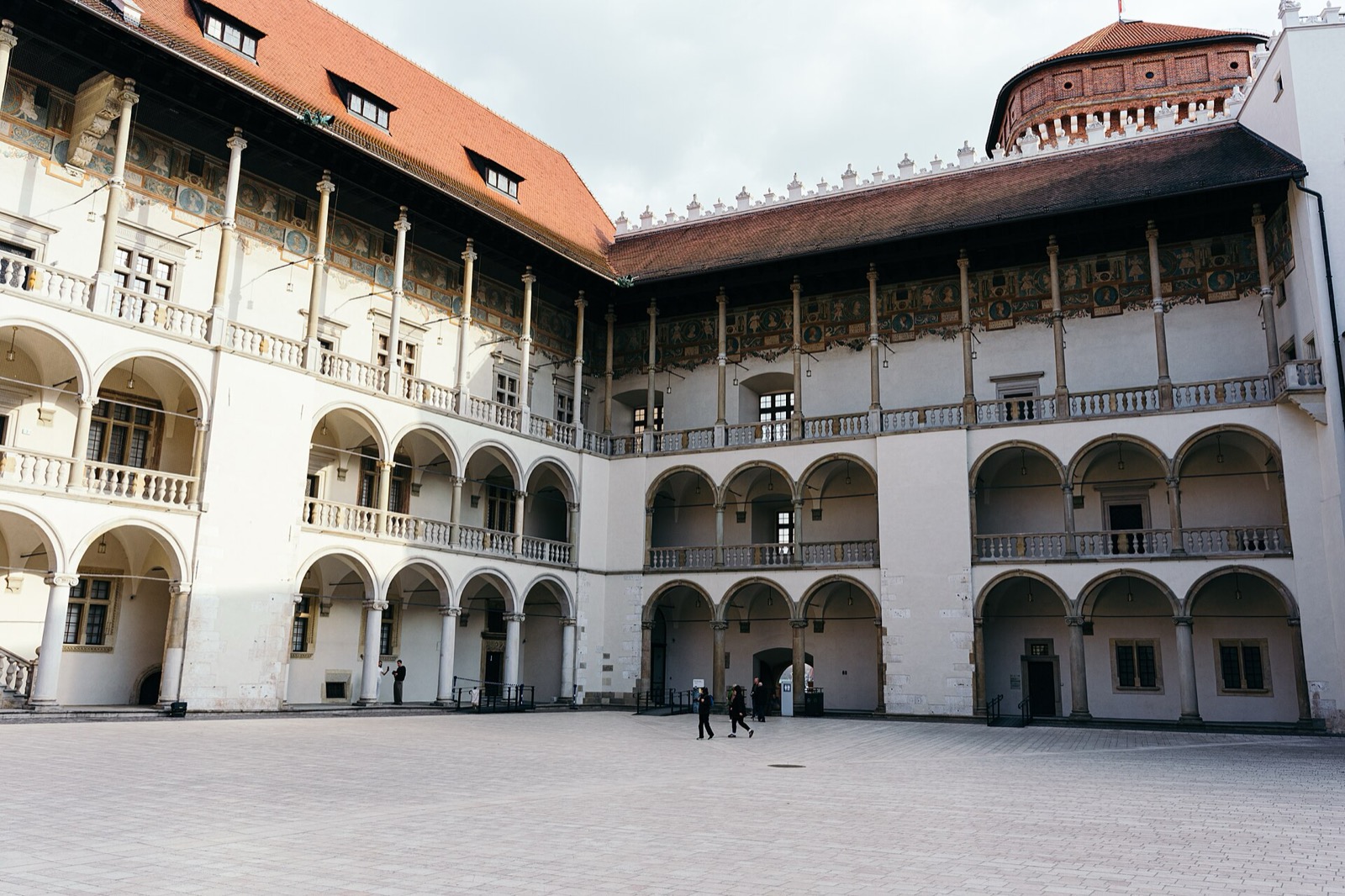
There is no such thing as a Wawel ticket. That is the first thing to understand about the hill, and almost everyone learns it standing at a ticket window with a queue behind them.
Wawel is not one museum with one door. It is a walled hill holding half a dozen separate exhibitions, each with its own price, its own entry hour and its own opening season — plus a cathedral that belongs to a different organisation entirely and sells its own tickets. You choose what to see before you go, or you choose badly on the spot.
This is what each route actually opens, how long it really takes, and which one to buy if you are buying one.
The short answer
If you see one thing, see the Castle. The State Rooms and the royal apartments are the reason Wawel is Wawel: the arcaded Renaissance courtyard, the Flemish tapestries Sigismund Augustus spent a fortune on, the Ottoman tents taken at Vienna in 1683. Everything else on the hill is an addition to that, not an alternative.
If you see two, add the Crown Treasury. It is small, it takes forty minutes, and it holds Szczerbiec — the 13th-century coronation sword, the only surviving piece of Poland’s medieval regalia. There is no substitute for standing in front of it.
Those two together are a comfortable half-morning and the best version of Wawel most visitors will get.
The routes, one by one
Castle — First and Second Floor
About 90 minutes. The one to buy.
The two floors are sold separately and together, and the combined route is the one worth having. The first floor is the private, domestic castle — the rooms the court actually lived in. The second is ceremonial: taller, colder, built for audiences and display, and where the castle feels most like a working royal residence rather than a museum.
The tapestries are the collection’s heart. Sigismund Augustus commissioned around 170 of them in Brussels in the mid-1500s; 138 survive, and they hang here. The Turkish tent collection on the second floor is the largest in Europe outside Istanbul, and it exists because the Polish army kept what it captured.
The combined ticket includes an audio guide, which on this route earns its place — the rooms are sparsely labelled by design.
Crown Treasury
About 40 minutes. The best small ticket on the hill.
Gothic vaults under the castle holding what survived the partitions: Szczerbiec, royal goldwork, insignia, gifts of state. Poland’s crown jewels were broken up and melted by Prussian officials in 1795; the sword is what is left. The room is quiet and the case is unassuming, which somehow makes it worse in the right way.
The Armoury
About 40 minutes. Buy it with the Treasury or not at all.
It adjoins the Treasury on the ground floor and is usually visited in the same breath — hussar armour with the winged frames, oriental arms taken in the same campaigns that produced the tents upstairs, cannon, banners. If you liked the tents, you will like this. If military history leaves you cold, skip it without guilt.
Castle Underground
About 45 minutes. For people who like the layer underneath.
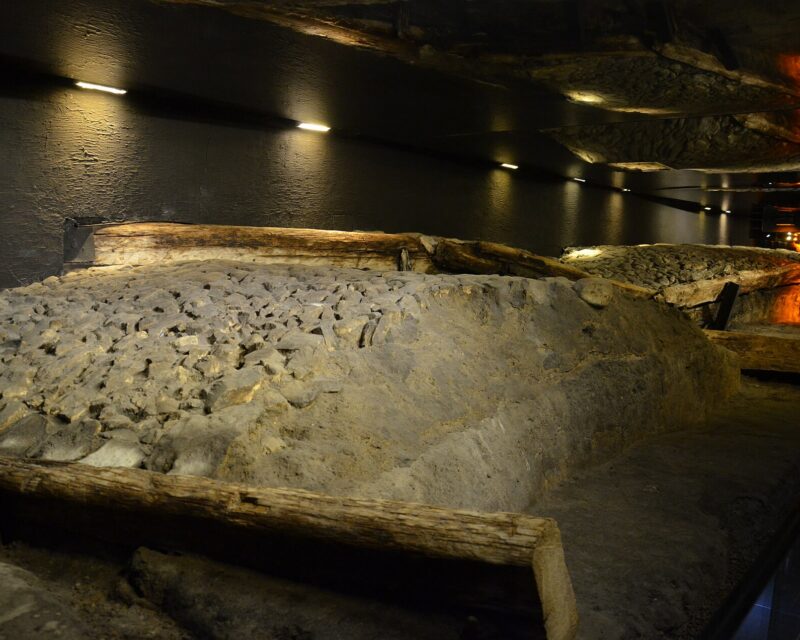
Sold as the Lost Wawel: the pre-Romanesque rotunda of St Gereon, foundations of buildings that stopped existing centuries ago, a lapidarium of carved fragments. This is archaeology rather than spectacle, and it is genuinely absorbing if that is your register. It also comes with an audio guide, and it is one of the exhibitions most often included in Monday’s free allocation.
Dragon’s Den
About 15 minutes. Seasonal. Bring children or skip it.
A limestone cave in the hill, 135 steps down, exiting onto the riverbank beside the fire-breathing dragon sculpture. It is a legend, a short walk and a photograph, and children love it. Adults travelling without children can miss it and lose nothing.
It opens roughly late April to the end of October. Outside those months the entrance is simply shut — along with two of the other six routes.
Sandomierz Tower — the viewing platform
About 20 minutes. Seasonal. The best view in Kraków.
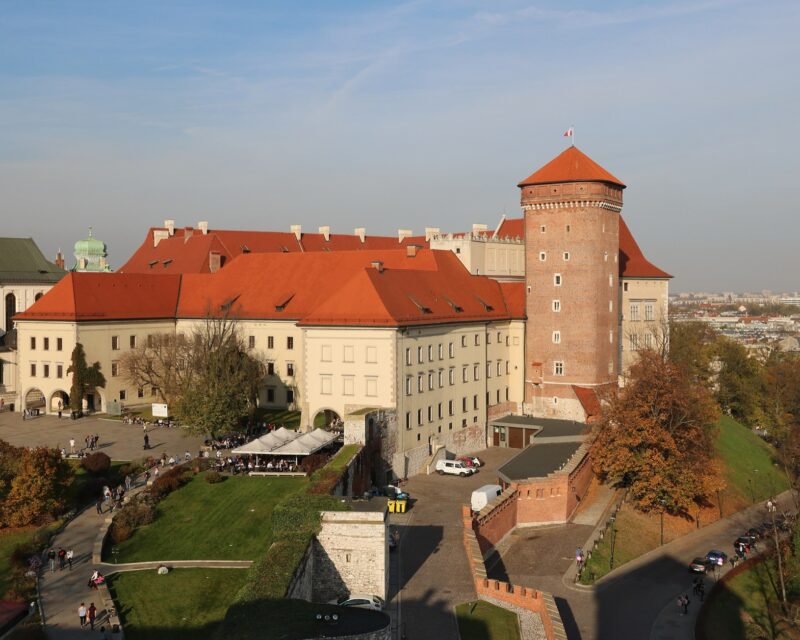
A climb up the tower for a full panorama: the Old Town roofs one way, the bend of the Vistula the other, the cathedral domes close enough to read. It is the cheapest ticket on the hill and, in good light, the one people remember. Also late April to end of October only.
It and the gardens are the two routes no guide bothers with, which is why we gave them one of their own.
Royal Gardens
About 30 minutes. Seasonal, and often already included.
The reconstructed Renaissance terraces on the southern slope, planted as they were under the last Jagiellons. A short season — roughly late April to early October — and worth knowing that the gardens are included with most castle tickets rather than needing their own. Check what you already hold before you buy it separately.
Three things that catch people out
The cathedral is not included
Not in any castle ticket, at any price. Wawel Cathedral, the Royal Crypts, the Sigismund Bell and the Cathedral Museum belong to the archdiocese, not to the castle museum, and are sold at a separate ticket office opposite the cathedral door. This is the single most common mistake on the hill, and it is worth reading the full explanation before you go.
Monday is not a normal day
Most exhibitions are closed on Mondays. A small number open with free admission, the selection changes through the year, the tickets are handed out at the windows only — not online — and they are gone early. Monday is a fine day to walk the hill and a poor day to plan a visit around seeing something specific.
Entry hours are per exhibition, not per hill
Each route admits at its own timed slots, and daily numbers are capped. Two tickets bought for the same afternoon can easily be an hour apart, which is fine if you planned for it and irritating if you did not. Book the entry hours together and leave twenty minutes between them; the hill is bigger than it looks from the ramp.
What costs nothing
The hill itself. The outer courtyards, the arcaded courtyard, the ramp, the walls and the river view are all free to walk, from early morning until late evening. If you arrive with no ticket and no plan, you can still have an hour of Wawel — and the courtyard alone is worth the climb.